Contact us
Source code
Features
The recruitment process
Those famously unbiased, next‑gen enterprise-grade NGAV solutions that never miss a thing
AV-TEST/AV-COMPARATIVES
LLVM-EX howto
A kernel‑level network connection hiding
A great invasion of your privacy
Data breach
Kernel-mode anti-cheat
HEX DEREF ANTI-MALWARE X: Zero-Trust mode at the application/process level
 The project price starts at 4,999 USD in BTC, which must be paid upfront once you have accepted the software work agreement. Please also include your Telegram in the email (without it you will not receive a reply). Thank you.
Source code
Features
The recruitment process
Those famously unbiased, next‑gen enterprise-grade NGAV solutions that never miss a thing
AV-TEST/AV-COMPARATIVES
LLVM-EX howto
A kernel‑level network connection hiding
A great invasion of your privacy
Data breach
Kernel-mode anti-cheat
HEX DEREF ANTI-MALWARE X: Zero-Trust mode at the application/process level
An unknown malware threat - UNKNOWN-123 project
Detection‑response based security does not necessarily recognize (and therefore cannot protect against) unknown threats,
including new malware. This limitation applies to virtually all vendors listed on VirusTotal.com as well as the
majority of enterprise‑grade security providers, since they rely primarily on signature‑ or pattern‑based detection.
Behavior‑based detection can easily generate false positives, because the same actions can be used for both legitimate and malicious purposes.
With only a few exceptions, based on the author's earlier testing with unpublished malware sample — unknown
threats are typically discovered and addressed by these legacy detection‑based endpoint security solutions only
after they have already caused damage to their customers.
An anti‑virus solution or malware can map out most of a company's internal network simply by examining the process list and their network connections — all without the user or the organization noticing.
And when you think about unauthorized actions performed by an endpoint security solution, this would definitely qualify — yet at the same time it's also part of the core functionality these systems rely on.
Think about home users who work remotely and read their email with something like Thunderbird, which is a popular free email client. If they rely solely on Defender, it will not even react when a running piece of malware maps out the company's connections and steals their credentials in the process. As a result, a corporate email compromise can occur without the user ever noticing.
Malware built for industrial espionage enumerates the network connections of active processes, including things like payroll systems. After it gains kernel access, the keylogger activates, and you can imagine the outcome.
A piece of malware running under standard user rights can inspect the process list to determine whether any process exposes a potential CVE‑????‑????‑type vulnerability that could be leveraged for privilege escalation.
You might be very mistaken when you say that even Defender is enough. It's not that straightforward once you understand what's happening under the hood and grasp the full concept.
Some of the most dangerous unknown threats are code-signed malware or ransomware that exploit previously undiscovered zero‑day vulnerabilities.
Modern offensive AI models can now identify exploitable bugs far faster than any human researcher. This represents an entirely new level of capability in both
cyber offense and defense.
At some point the malware has to report back to its operator that it has spread to a new device, and that C2-communication is
the most critical detection vector for malware.
HEX DEREF ANTI-MALWARE X: Zero-Trust mode at the application/process level
This is precisely where the kernel-level allow‑listing becomes critical: new and unknown threats simply do not execute in the
first place. As a result, hunting for new threats becomes dramatically simpler and faster, because the only things
that need to be examined are programs that have never been used within that organization before.
This is exactly why HEX DEREF ANTI‑MALWARE X includes a fully functional kernel‑level Authenticode verification mechanism: unknown or unsigned code simply never executes, not even for a fraction of a second, unless it is explicitly on the allowed list.
The solution runs alongside every endpoint security solution and kernel‑level anti‑cheat. Malware doesn't know that this is an analysis tool.
A great invasion of your privacy
Possible data collected by these solutions:
- Browsing history including Tor-browser
- Process list
- Processes command‑line data and network connections
- Internal network URLs may also end up being sent, since it may not be able to tell internal addresses apart from external ones
- File history
— — An endpoint security product has visibility into virtually everything that happens on a device.
Typically, an antivirus or endpoint security solution transmits a list of running processes from the endpoint, along with their digital signatures.
If the solution also collects process-level network connection data, it inevitably reveals information about the services, systems, and software deployed within the organization's environment.
This can also expose the industrial software in use. All collected data is ultimately transmitted to external parties.
This is no longer solely a cybersecurity concern, but also a potential industrial espionage risk. For this reason, organizations should carefully evaluate which antivirus and endpoint security solutions they deploy across both corporate workstations and home computers.
What data do endpoint security solutions collect (e.g., those listed on VirusTotal.com)? Browsing history is usually sent without an opt‑out option. File names, sizes, and their hashes (SHA‑256), because without this
information traditional anti-virus products cannot determine whether an executable (or some other file) on the device is malicious. Nothing on a user's device should be transmitted to a vendor's
servers without explicitly asking the user for permission, otherwise the endpoint security product itself is performing
unauthorized actions — effectively a data breach. At this point we are approaching GDPR violations, and this could even lead to the revocation of the EV code‑signing certificate. None of the above can be disabled through any antivirus solution's settings.
You are browsing the internet with the Tor browser. Does no one wonder whether your Tor browsing history might still be present in some AV's memory even if you disable real-time protection? Keep in mind that the kernel driver may still be running there. At least Defender properly unloaded its driver when real-time protection was turned off. When turning Defender back on, my software showed that its driver was loaded again into kernel memory.
Data breach
A single breach can compromise weapons development, military readiness, or national security — and in many cases, one data breach is enough to expose a company's most critical trade secrets. For a software company, that means the source code; for a pharmaceutical company, it means proprietary formulas and manufacturing processes; and for other industries, it may be the core intellectual property that defines their entire competitive advantage.
Let's start by signing you in and bringing over your passwords, browsing history and more from Microsoft
Cloud. If this data cannot be accessed for one reason or another, then in practice the instance or the
entire company is unable to operate — even payroll would become impossible to process.
The protected folders feature already hint at where one should start. What I mean is that if the Endpoint Security solution ever turns against the company it was supposed to protect, the situation becomes a real security risk. And this is exactly why having the source code available removes any doubt.
Also, how many endpoint security products even ask for permission before sending a file to their servers for further analysis? If you have never seen such prompts, that alone should be a reason for concern.
A local database can be encrypted if needed, but the moment the data is automatically pushed into U.S.-based cloud services, there are no guarantees about how that data is used or who can access it.
Under the U.S. CLOUD Act (2018), American authorities can compel U.S. companies to hand over data even if it is stored outside the United States. That is the core risk.
It is somewhat unusual that browser history is collected by default with no option to disable it. In environments where internal payroll systems or other browser‑based applications operate within the corporate network, this design effectively shifts trust toward external products instead of leveraging a domestic, source‑available, and competitively developed solution purpose‑built for such use cases.
Considering that 'URLs visited' is collected, it also includes every document opened in the browser. So how is it possible, given all of this, that there is no interest in developing an open‑source solution where this can be disabled in the settings?
OV code‑signing
signtool sign /f MyOVCert.pfx /p MyPassword123 /fd SHA256 /tr http://timestamp.digicert.com /td SHA256 MyApp.exe
EV code‑signing
signtool sign /n "My Company Name" /fd SHA256 /tr http://timestamp.globalsign.com /td SHA256 /csp "SafeNet Key Storage Provider" /kc "MyEVKeyContainer" MyApp.exe
Usually files are named according to what they relate to. For example Supplier_shipments_03-2025.xlsx or
Packaging_equipment_project_xyz.xlsx.
It all depends on the company's naming standard.
When a traditional anti-virus solution performs a "Scan all files" operation (IoC), it could, in principle, enable
industrial espionage without the user's awareness, based solely on file names.
To my understanding, no endpoint security product or kernel-level anti-cheat system is permitted to transmit
any files from a device without first obtaining explicit user consent;
doing so would be functionally comparable to an information-stealing malware. In many products, automatic sample submission is enabled by default.
However, many products enable automatic sample submission by default, and the terminology used does not always clearly distinguish between different types of files. In particular, it is often unclear whether “automatic sample submission” refers exclusively to executable PE files—such as EXE, DLL, and SYS files—or whether other file types may also be submitted automatically.
This distinction becomes particularly important when the file in question is, for example, a private, non-public internal .NET 8.0 application that an organization has spent years developing. Such software may contain proprietary source code, intellectual property, business logic, credentials, configuration data, or other sensitive information. If such a file can be automatically collected and transmitted to a third party without the organization's explicit knowledge and consent, there may already be significant data protection and GDPR compliance implications.
As a result, personal data may be sent from your device. At some point you have to trust something. The test malware mentioned in the article does not send anything out from the device — and even if it did, the data it sends is not used for any malicious purpose. There are no guarantees about how the data is used or who can access it, despite the polished privacy statements. And if we consider features like protected folders, that alone would already point to a very clear place to start.
A data breach already occurs at least partially the moment your sensitive data is transferred into a third‑party cloud service. All of that data should be encrypted or otherwise protected before being uploaded to any of these services.
What puzzled the author even more was that in none of the data‑breach investigation reports or ransomware incident analyses was there ever any mention of what cybersecurity solution the affected organization had been using — or whether they had any at all besides Defender.
One of the services (CIR) charged a 5,000 USD upfront fee and then 300 USD per hour. That's far from inexpensive, especially when the site provides no description of the service.
And a reinstallation won't do much if the attacker gained access through a zero‑day vulnerability.
In any case, breaches like these shouldn't be happening very often — if at all — at the device level when using a solution like HEX DEREF X - ANTI‑MALWARE, assuming it's operating in a zero‑trust mode.
If the root cause was a zero‑day vulnerability, the attacker is likely to return unless the ransom was paid.
The author even contacted several of these CIR providers and quickly realized that many of them are essentially cash‑grabs or outright scams.
Determining the root cause of a data breach isn't quite that straightforward.
Malware may be deployed through remote access using credentials exposed in a breach, insider-launched malware, an undisclosed 0-day vulnerability,
or triggered accidentally by an employee without malicious intent.
If you rule out all other possibilities, the only thing left is the data collected through the core functionality of the endpoint security itself — data that can ultimately be used against the very organization it was originally meant to protect.
Kernel-mode anti-cheat
A virtualized anti-cheat loads into the kernel, it gains the ability to run sensitive or potentially dangerous operations unchecked.
For example, the Chinese Anti-Cheat Expert (ACE) system (a kernel-level anti-cheat solution for the Windows platform), developed by Tencent Cloud, blocks all known monitoring tools such as ProcMon64, DebugView, and System Informer.
HEX DEREF X - Anti-malware, the core functionality of these tools is implemented at the kernel level, but the UI still requires updates.
ACE does not recognize HEX DEREF X - Anti-malware as a kernel-level anti-cheat analysis tool. The goal is to perform a full runtime analysis as soon as I finish updating the UI.
HEX DEREF X- Kernel-mode anti-cheat
LLVM-EX virtualized sandbox aware malware
HEX DEREF X- Kernel-mode anti-cheat
Using a tool like llvm-msvc-ex to virtualize
your malware can significantly increase the complexity of reverse engineering or modifying the code.
This is because virtualization techniques, such as control flow flattening, bogus control flow, and VM-based
obfuscation make the malware harder to analyze and understand. These techniques can deter attackers or researchers from
tampering with or reverse engineering the malware.
With the right LLVM-EX obfuscation passes, a C/C++ malware sample automatically becomes a unique version that pretty
much evades all malware analysis sandboxes.
Reversing an LLVM‑virtualized piece of malware (especially reversing the C2 communication) requires
significant expertise, and time. It demands a highly skilled professional team.
As a loader-type malware, each version is automatically unique (string encryption and so on). Static detection
therefore lags far behind, and based on my initial tests,
this got through of all enterprise solutions — even those that proudly advertise themselves as so‑called
leading solutions.
Likely renders even a sophisticated sandbox largely ineffective, ultimately forcing devirtualization, and a dynamic analysis.
This version of LLVM-EX has been modified so that you can provide a list of functions as a parameter, which will then be obfuscated/virtualized.
Because if we're talking about a P2C, you obviously can't obfuscate the entire
executable for reasons that should be quite self‑evident.
Those famously unbiased, next‑gen enterprise-grade NGAV solutions that never miss a thing
How can you do threat hunting for new, unknown threats with such limited or non-existent process and command‑line
data — not to mention the missing process network connections? You can't easily determine the root cause of a breach
at the process or device level if the device user or SOC doesn't have unrestricted access to this crucial
information. Or can you? If you've read even a single analysis of a somewhat sophisticated ransomware strain, you'll
know that even today's basic ramsonware variants wipe all logs and make forensic analysis on the disk extremely difficult, if
not nearly impossible.
Full size
An endpoint security solution that doesn't even inform the user at a basic level about possible malware registry persistence has
received full scores/awards in these tests. The site refers to an award‑winning solution.
My intention was also to highlight the misleading product marketing used on these sites. This is highly questionable
behavior and amounts to distorting fair competition. Customers end up purchasing a product that does not match the
description advertised on the website.
A malware analyst from the same company — or another one — writes an article about the malware's persistence. But
why doesn't their own solution even notify the user that a process added persistence? Or maybe they sacrificed features for the sake of stability, leaving the product mostly with static detection.
The test malware purpose is to highlight possible shortcomings or biases in the tests conducted by
"AV-TEST/AV-COMPARATIVES" certification organizations
Some endpoint security solutions advertise a 100% detection rate. There is no such product that can automatically detect all previously unknown malwares, because any potential threat requires static and dynamic analysis, and afterward the C2 communication must be reverse‑engineered to prove malicious behavior.
Makes me wonder if there's some bias in these tests, since none of them answered my question (As of 08/2026, I have been waiting for roughly a year without receiving any response) about whether they have ever tested with a previously unpublished malware that has no static detection.
Whenever someone releases something for free, it undermines the competition. And then when you try to build
something commercial around the same idea, the first thing people ask is: what makes yours better,
and why should anyone pay for it — especially when Windows Defender is free. With investors, even garbage can turn
into a scam.
An endpoint security solution that does not even alert the user about behavior that is clearly characteristic of malware, not even at the most basic level.
This information has been publicly available for at least a decade, long before generative AI existed. So how is it possible that such a product has received perfect scores in every test?
As per of my actual testing, CrowdStrike's sandbox assigns a 10 percent malware confidence score solely because a C++ application checks whether it is running with administrative privileges. This is a serious design flaw. I bypassed the sandbox detection by virtualizing the code, demonstrating both the limitations of current static-analysis approaches and my long-term experience as a tester. Because of these issues, it is impossible to publish any public version of the HEX DEREF X - ENDPOINT SECURITY without proper EV code-signing.
There is no such thing as a truly free antivirus solution. There are no guarantees about how the collected data is used or who has access to it.
Microsoft's CompatTelRunner.exe is a well-known example of deep system telemetry. The real issue is not the data collection itself, but how the collected information is processed, shared,
or sold to third parties regardless of what the privacy policy claims.
In a zero trust model, you cannot automatically trust any external component, service, or vendor. Without access to the full source code and without keeping all critical data on your own servers,
you have no way to verify what is happening behind the scenes. Trust must be earned through transparency, not assumed by default.
Full scores have been achieved in several tests, and the product has become award‑winning. However, these tests are performed using known malware samples. Static detection inevitably lags behind unknown threats, and signatures or heuristics cannot protect against something that has never been seen before. This is why test results alone cannot be the basis for trust in a zero‑trust model.
There is no solution on the market that achieves 100% detection. It is also important to note the misleading
marketing claims found on various vendor websites, where long market presence is implied to equal superior
protection. Market research shows that many, if not most, vendors sell multiple product versions under different
names, even though the actual technical differences between them are often purely cosmetic. The screenshot below,
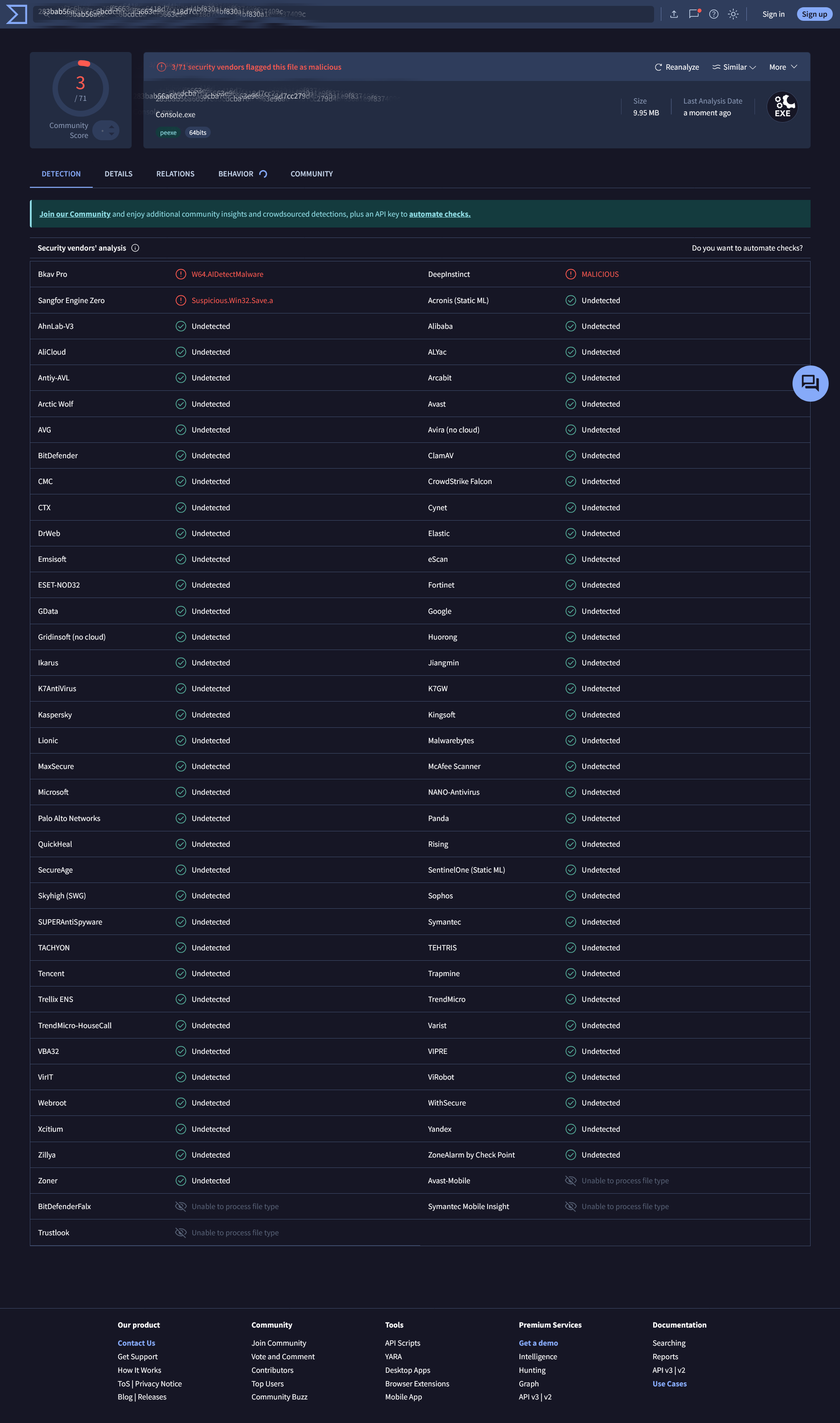
captured during my unbiased testing, supports my claims.
The detections are primarily caused by a classic false positive caused by virtualization/obfuscation. Sandbox environments that rely on static analysis may generate false positives, because virtualization often produces high‑entropy code that resembles obfuscated or malicious payloads. This is exactly the flaw in such systems: commercial software must virtualize certain components, for example the function that binds a license to a specific device (HWID‑locking), and this legitimate high‑entropy code is frequently misclassified as malicious.
By reading the /r/Malware subreddit. It becomes clear that new malware and their variants emerges daily. An anti‑virus solution
that relies solely on static signature‑based detection is a thing of the past. And honestly, if an endpoint
security product can't even alert the user when a program exhibits behavior typical of malware, that should raise
serious concerns. What other approach besides kernel‑level allow‑listing based endpoint security can realistically
stay ahead of these threats? Solutions like HEX DEREF ANTI‑MALWARE X demonstrate why deeper, kernel‑integrated
defenses matter.
An LLVM‑virtualized piece of malware can bypass virtually all static detection mechanisms and turn analysis into an
excessively time‑consuming process (as shown above). Although competing vendors may publish articles about their malware‑analysis
capabilities, my preliminary testing suggests that many of the issues highlighted in those write‑ups remain
unaddressed in the actual product implementations. It reminds me of a situation where a professional team was hired
to analyze malware but chose not to consult the developers responsible for the kernel‑level sensor — a rather
puzzling decision.
When you look at the industry's marketing, certifications, and the flawless scores handed out by testing labs, it's
easy to believe that today's security products are fully prepared for real‑world threats. But the reality is far
less reassuring. When an actual, modern cyberattack strikes, all those polished numbers and promises evaporate in
seconds. That's the moment when the thinness of the protective layer becomes painfully obvious — and it happens only
after the damage is already done. Organizations discover too late that the tests never reflected real adversaries,
and the marketing never told the whole story. A cyberattack doesn't wait for anyone to update reports or adjust
scoring criteria. It exposes what works and what doesn't, and it does so only after the consequences are already
irreversible.
The consequences of an impossible recruitment process.
When I applied for these positions (for example, a Windows kernel sensor developer. This already requires highly
specialized expertise), I attached a clear proof‑of‑concept video to my application — which, in most cases, was
exactly what the job posting was asking for.
I got the impression that these recruiters don't even conceptually understand how malware or endpoint security
works, and therefore have no real idea who they should be hiring.
In most cases I didn't receive even a basic reply to my open applications, even though I demonstrated a Zero Trust implementation at the application/process level — something you won't find in other products.
The skill set presented in this article doesn't seem to meet the expectations of these recruiters. The videos attached to the article were produced with the dedication of a single person over a long period of time,
yet they still weren't good enough for those who only crave shallow, trivial content.
Your product development simply can't keep up with the competition when you refuse to hire the right talent.
The recruitment process somehow seems to support the idea that sensitive data is being collected without
permission under the pretext of various features — unless the entire solution has been deliberately designed for spying on the user
in this case, the endpoint security solution ends up turning against the very company it was originally meant to
protect.
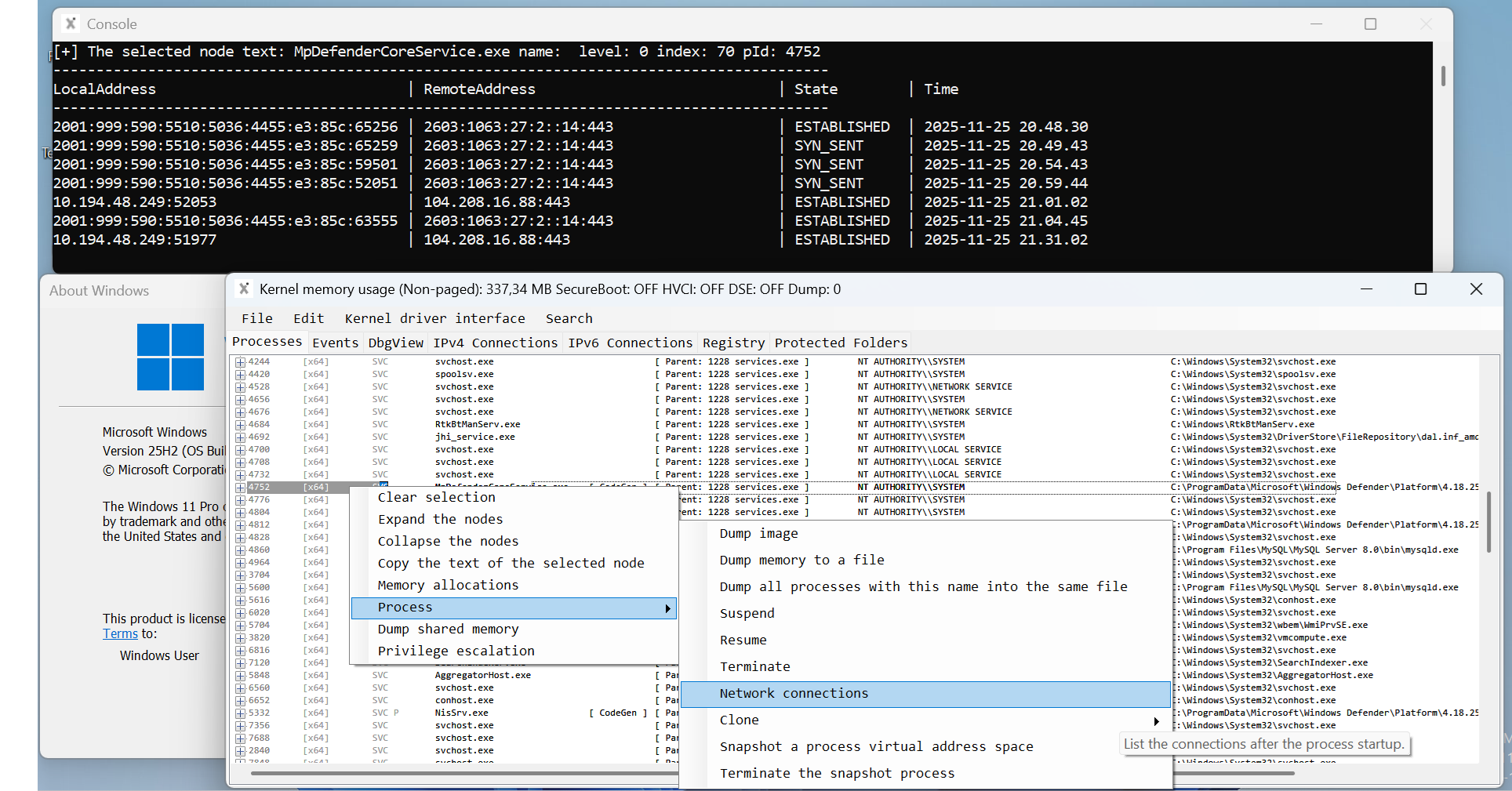
Kernel‑level malware - Capable of hiding a network connection at the process level (Windows 10 22H2 - Windows 11 25H2)
- Block process network queries entirely, or only for a specific process PID
Hiding a process's network activity from other applications. Hide connections belonging to a specific browser or VPN
process. This is a unique C/C++ user‑mode (UM) / (KM) Windows kernel‑driver implementation.
This allows you to limit which user processes may request network connections. The kernel‑level equivalent of
netstat -ano. It even works in a manually mapped driver. This isn't about hiding from the user — it's about hiding
from malware.
Even malware running with only standard user privileges can map internal network addresses and the processes that connect to them. And since the kernel‑level attack surface has been overlooked for years, the most
severe ransomware attacks can still succeed. And now, with that same capability, it is also possible to hide the network
activity of a RAT‑type malware including C2-communication.
Network connection hiding – Hide network connections from tools like netstat, and also from any other user‑mode processes that query connection information through the NSI layer.
As a malware‑analysis feature, this is a useful capability. You can immediately see all user processes that are querying other processes network connections.
It was a blind spot — a quiet for at least a decade, undocumented subsystem that malware could hook without triggering PatchGuard.
Isn't it strange that something like this still slips past of these endpoint security products, and yet the testers keep handing out perfect scores in every single test.
https://securelist.com/daemon-tools-backdoor/119654/
This is precisely why HEX DEREF ANTI‑MALWARE X logs all process network connections into its database without restrictions, and why home users have the option to disable this feature — the solution respects user privacy, unlike all the others.
Does the reader now understand what this is about? Shouldn't the privacy statement clearly mention that it logs all process network connections?
Think about a person who works remotely and connects from a home device to the company network.
If it's, for example, remote support, the cybersecurity software on that device ‘sees' which company network process X connected to.
In a wartime situation at the latest, the data that has been collected may start being used for cyberattacks.
This kind of thing has been running around undetected on both personal and corporate devices for, what, about a decade now on users devices without them having the slightest clue.
The source code of the UNKNOWN‑123 project
I published this project for several reasons. One of the reasons is to support my job applications.
Secondly, something like this is needed for testing the logic of an endpoint security solution — and of course for unbiased EDR/NGAV endpoint security product testing.
That is why the test project's UNKNOWN-123 source code is available
for purchase as a software work for educational and informational purposes only.
The source code is sold as software work for APT simulation, which mirrors a real cyberattack.
Features
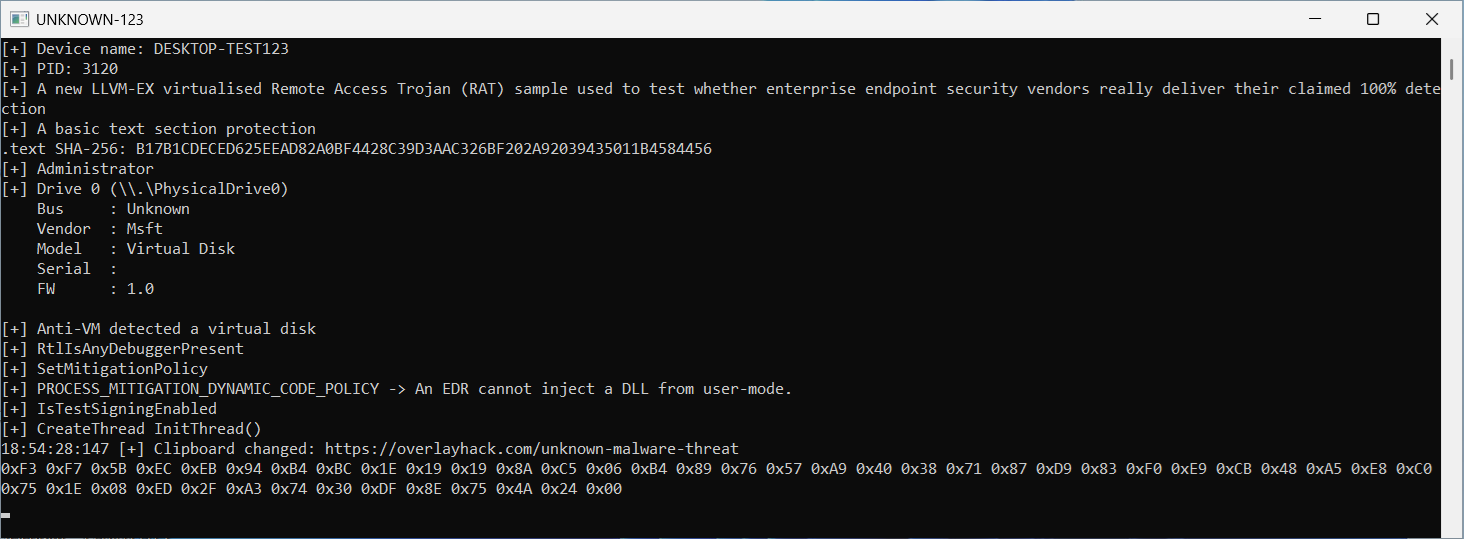
Coded in C/C++. It operates and performs actions depending on whether it is running as a regular user or with administrator privileges.
The settings are configured in the Config.h file, meaning it cannot be identified based on command‑line parameters. LLVM‑EX virtualization makes every build unique, so static detection does not work against it.
- Anti-VM
- Anti-Debug
- Anti-Inject
- IAT Hiding
- Clipboard DATA
Isn't this essentially what you'd implement for a kernel‑level anti‑cheat SVC process? All of these features are commonly used in commercial software to provide even a basic level of copy protection. For example, using the disk's serial number allows you to bind the license to a specific device. And for obvious reasons, any function related to copy‑protection must of course be virtualized.
Anti-VM: Sandbox aware malware can render even a sophisticated sandbox largely ineffective, ultimately forcing a manual analysis. If malware detects that it is running in a virtual machine, it may refrain from executing any malicious actions.
The project price starts at 4,999 USD in BTC, which must be paid upfront once you have accepted the software work agreement. Please also include your Telegram in the email (without it you will not receive a reply). Thank you.
White Byte © 2026 OVERLAYHACK.COM - DO NOT REPRODUCE CONTENT WITHOUT PERMISSION